
What is “Rock ‘n’ Three,” the much-talked-about ramen shop that drew a line of 200 people on its opening day, September 25, 2025?(2)
《Japan Ramen Guide/日本拉面指南》
Menkui Wanderer(麺喰ワンダラー)
The Spread of Water Chicken Ramen
The existence of No. 2 Ramen, developed by Junichi Shimazaki, shocked not only ramen lovers but also ramen shop owners. If we compare 69’N’ROLL ONE to a river, it would be the upper reaches of a river bubbling up from the mountains. Located midstream of this river were Iida Shoten(飯田商店) (The flavor was later renewed) and Toy Box(トイ・ボックス, Minowa sta.), both of which are now said to offer “Japan’s best ramen.” Iida Shoten has won the TRY Ramen Award four times in a row and is now inducted into the Hall of Fame. The following year, Toy Box won the grand prize, achieving its fourth consecutive victory and earning a place in the Hall of Fame. While Shimazaki was away in the Kansai region, these two restaurants maintained the “clear soup era” for eight years.
Many “water chicken ramen” restaurants were born downstream (not necessarily lower-level restaurants, but restaurants influenced by the upper and middle streams). This spread not only to the Tokyo metropolitan area but also to the countryside. Several restaurants have even topped the prefecture ramen category on gourmet websites. Ramen restaurants were first listed in the Michelin Guide in 2015. The “ramen category” was introduced in 2016. Many of the restaurants featured were characterized by their “clear soup.” While not all of them were “water chicken” restaurants, their popularity has undoubtedly increased.
Even I, who likes to visit new restaurants, sometimes found myself growing tired of the sheer number of water chicken ramen restaurants. Water chicken ramen is so simple, yet so difficult. For example, some restaurants don’t bother to add chicken oil twice (first pouring the chicken oil into an empty bowl, then adding the sauce, then the soup, and finally adding the chicken oil). Simply making it with water and chicken doesn’t make it delicious. Shimazaki uses 11 different types of soy sauce, resulting in an almost infinite number of combinations. “Shimazaki-style Water Chicken Ramen” is the result of dozens and hundreds of experiments. It’s not something you can easily imitate.
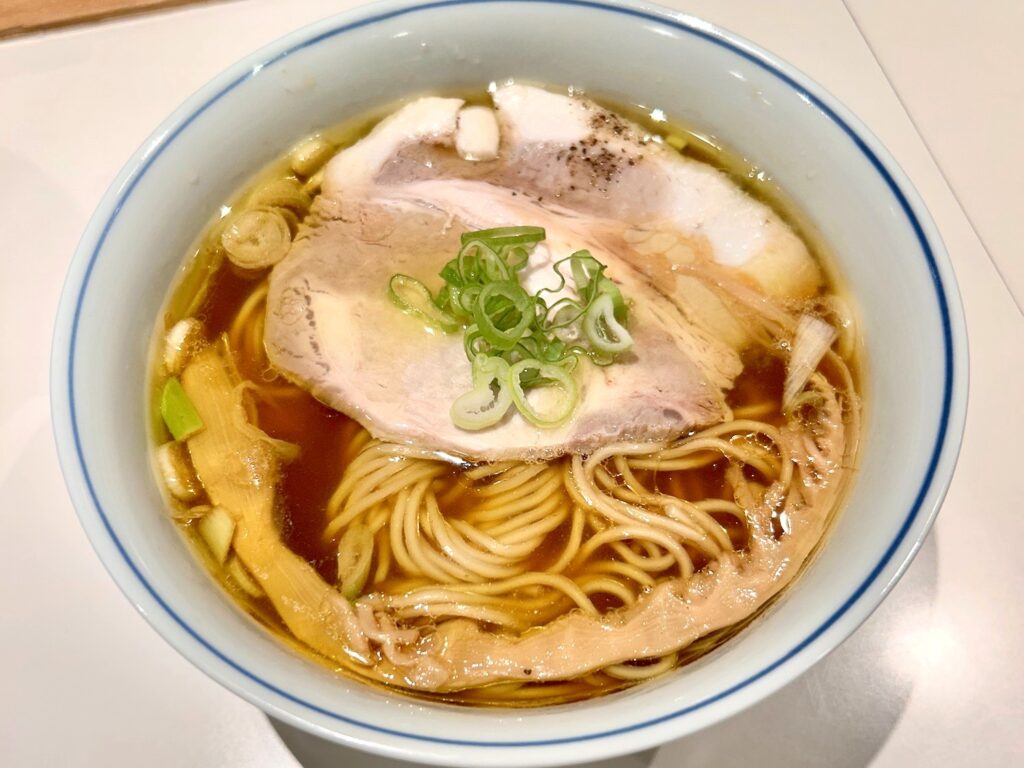
Then, one day, I had a business trip to Kansai, and I dropped into Rock ‘n’ Billy S1 for the first time in a while. Delicious! So delicious! It wasn’t because I was tired of it. More and more restaurants are just imitating the originals. When made properly, it’s truly delicious. Also, Shimazaki’s ramen has definitely evolved since his Kanto days. It evolved from Phase 1 to Phase 2, and now Phase 3. How far will it continue to evolve? The photo is from the pre-opening, so I won’t comment on my impressions. It’s changed dramatically. This marks the beginning of Phase 3.
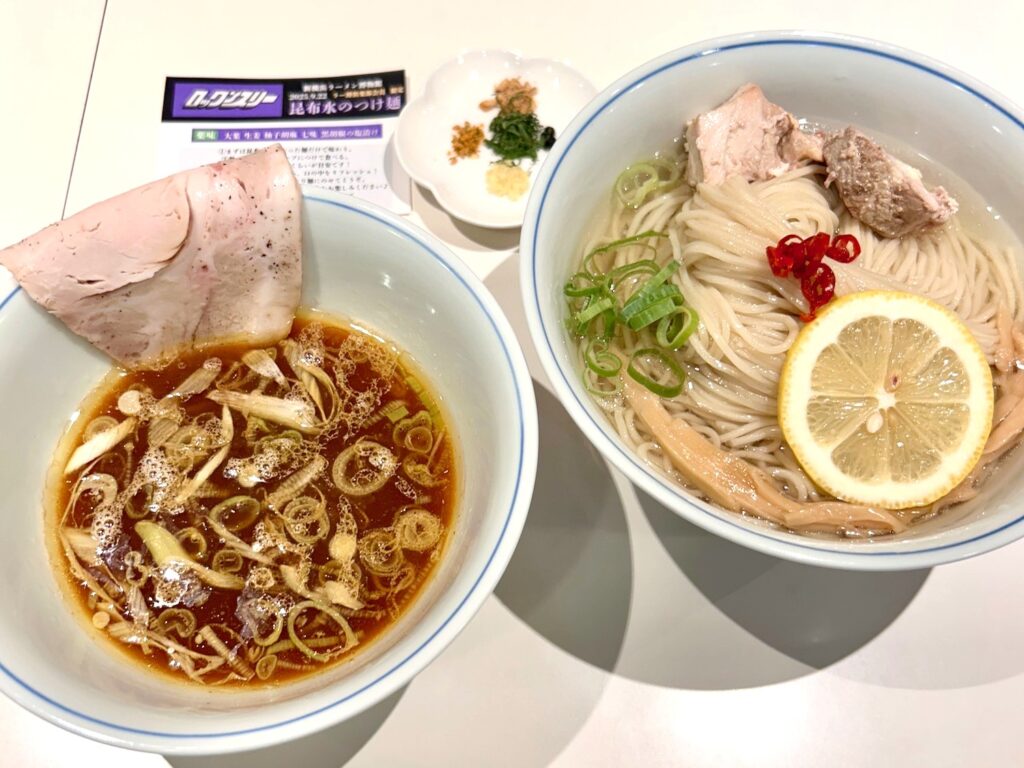
“Kelp-water Tsukemen (昆布水つけ麺 Kombusui Tsukemen”: A Groundbreaking Menu That Can Now Be Called an “Invention”
Looking back at the “TRY Book,”(※TRY=Tokyo Ramen of the Year) I notice that when the restaurant won the TRY Grand Prize in 2011, “No. 2 Tsukemen” was listed as another menu item, but the name “Kelp-water Tsukemen” hadn’t even been coined at the time. In fact, it didn’t even make it into the top 10 in the “Thin Tsukemen” category. In other words, even the judges, who eat 600 to 700 bowls of this tsukemen every year, didn’t realize how amazing it was that year.
Then, in 2012, “No. 2 Tsukemen” suddenly appeared as the top choice in the “Thin Tsukemen” category. Interestingly, it was only after Mr.Shimazaki moved to Kansai that the name “Kelp-water Tsukemen” and its explosive growth took off. It really does take time and years for something to “spread.”
So, what exactly is “Kelp-water Tsukemen”? Thin tsukemen noodles have a weakness: they tend to tangle (stick together). To overcome this, Mr.Shimazaki tried various dashi stocks, and concluded that kelp water is the best to pour over the noodles. However, this golden formula was born after numerous trials, including combinations of concentration and kelp origin.
The kelp water in the noodles (= glutamic acid) and the chicken broth in the dipping sauce (= inosinic acid) combine in the mouth, creating a synergistic umami effect through “mouth seasoning(口内調理/口中調味),” a true marriage. Mouth-level seasoning is a uniquely Japanese culture based on the principles of “one soup, three dishes(一汁三菜)” and “rotational eating(三角食べ).” Sushi is also said to be a mouth-level seasoning technique, where the vinegared rice and seafood “marry” in the mouth. Whether he knew it or not, he applied this Japanese tradition to tsukemen. A truly formidable solitary genius.
Now, kelp water tsukemen has taken on a life of its own, spawning a variety of styles. The originator is Shimazaki’s “No. 2 Tsukemen.” I believe this is as groundbreaking an invention as Yamagishi of Higashi-Ikebukuro Taishoken “invented” tsukemen.
However, this menu item is likely to become a rare treat, as it will be offered in limited quantities once things have settled down. The photo was taken on a day reserved for Ramen Museum Club members.
“RocknThree” (Shin-Yokohama Station, Yokohama City, Kanagawa Prefecture)
Official Information
1-9-1 Marunouchi, Chiyoda-ku, Tokyo 100-0005, Tokyo Station Ichibangai B1F
Autor of this article
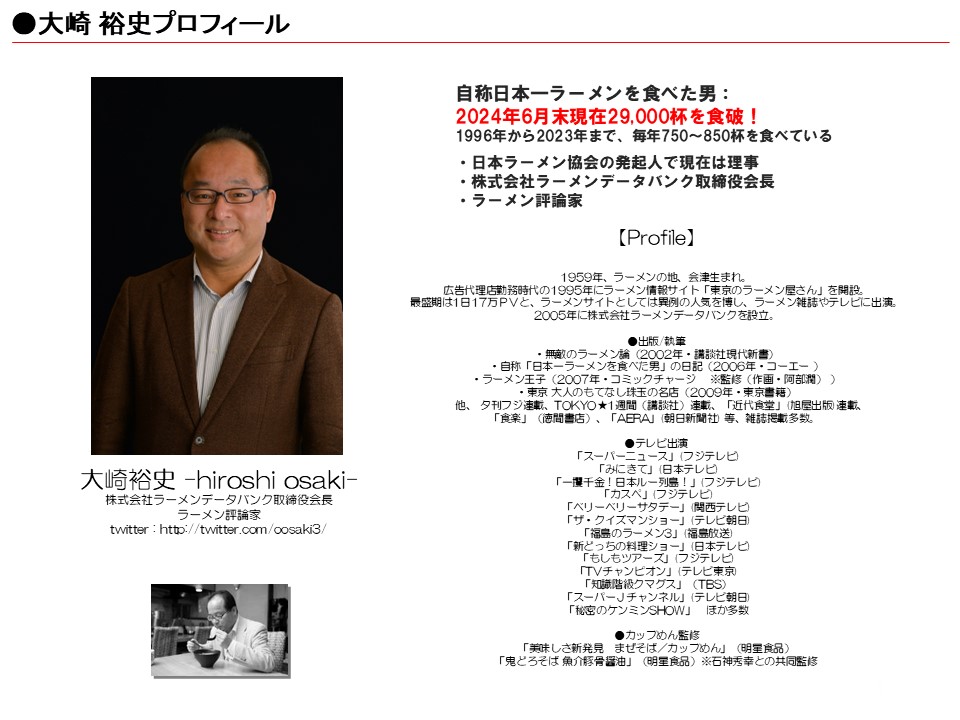
■Hiroshi Osaki (大崎 裕史); Chairman of the Board of Directors of Ramen Databank Co., Ltd. One of the founders of the Japan Ramen Association. Executive Committee Chairman of the Tokyo Ramen Festa. Born in 1959 in Aizu, the land of ramen. While working at an advertising agency, he launched the ramen information site “Tokyo Ramen Shops” in 1995. Founded Ramen Databank Co., Ltd. in 2005. Became chairman of the board of directors in 2011. He has appeared in many magazines and on television as “the man who calls himself the man who has eaten the most ramen in Japan” (as of the end of June 2024, he has eaten about 14,000 ramen shops and about 29,000 bowls). His books include “Muteki no Ramenron” (The Invincible Ramen Theory) (Kodansha Shinsho) and “Nihon Ramen Hishi(Japan Ramen Hidden Story)” (Nihon Keizai Shimbun Publishing).